







Russian officials have repeatedly warned that any NATO state allowing Ukrainian drones to use its airspace for strikes on Russian territory could become a legitimate military target, raising urgent questions about the likelihood of such retaliation. The article examines Moscow’s stated legal justifications, the deterrent power of NATO’s collective defense, and the specific thresholds that could trigger escalation thus while airstrikes remain improbable in the near term, the risk cannot be dismissed entirely.
By Miguel Santos García
In early April 2026, the Russian leadership reinforced its uncompromising stance through Federation Council Speaker Valentina Matviyenko, who declared on Olga Skabeyeva’s prominent talk show that Moscow will show no flexibility toward European Union nations that allow their airspace to be used for Ukrainian strikes on Russian territory.
“We are getting new terrorist attacks, attacks on our energy infrastructure, civilian facilities and people,” Matviyenko stated. “And we will not be flexible with everyone, we will not succumb to the threats of the Europeans or anyone else. We have issued very harsh warnings to these countries.”
She then offered a specific example of Russian pressure yielding results, noting that Lithuania had already publicly denied giving Ukraine permission to fly its drones. Matviyenko went on,
“That is, we shook them up… and they realized that if they continued, they would be our legitimate targets, because Russia was being attacked from their territory. They understood that. I think they’re going to crawl away now. They won’t say it out loud, but they’ll crawl away.”
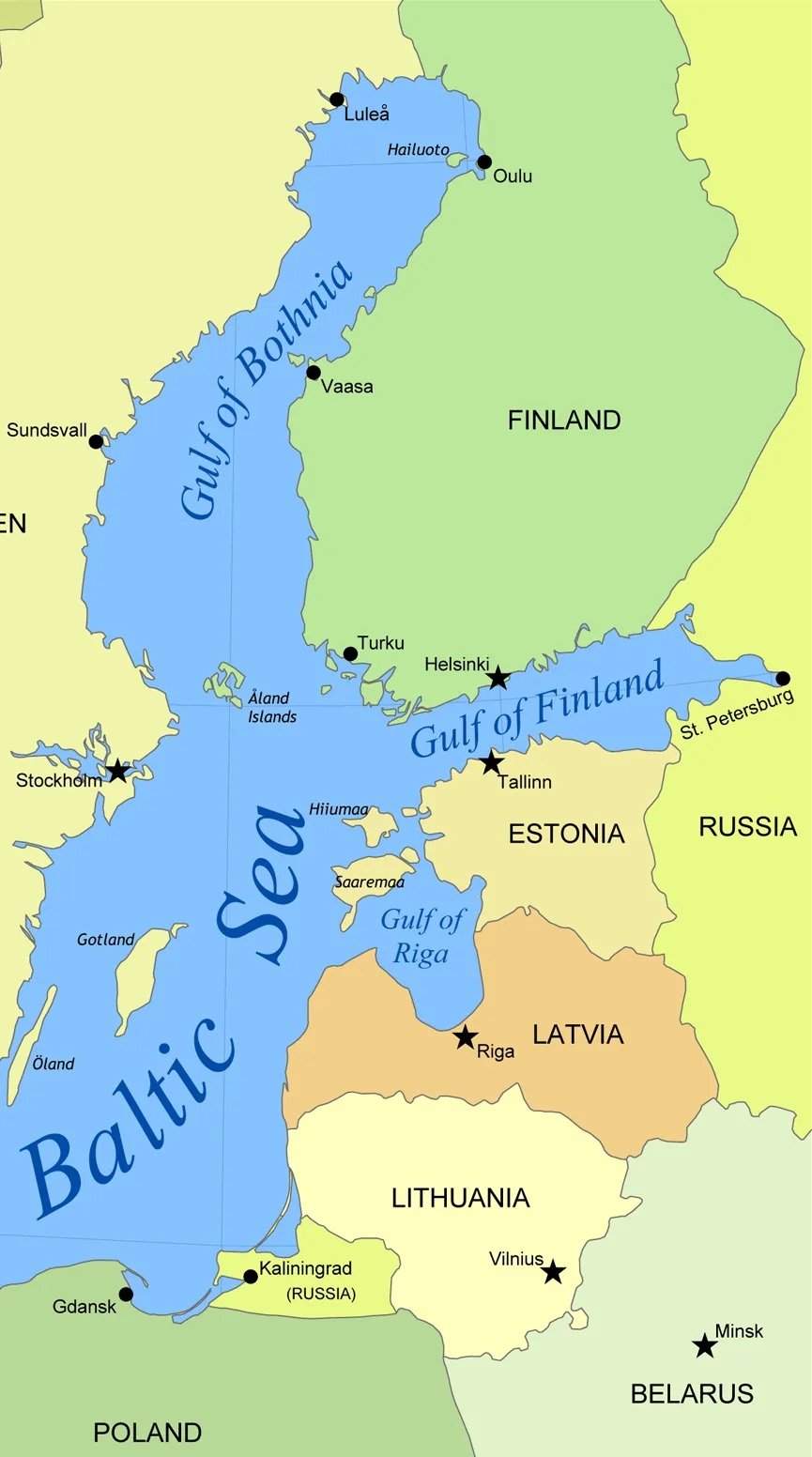
Then on April 10, a joint statement by the Ministers of Foreign Affairs of Estonia, Latvia, and Lithuania dismissed the accusations entirely, stating they considered this whole situation as Russia’s disinformation campaign. This was followed on April 16, when Russian Security Council Secretary Sergey Shoigu formally reminded Finland and the Baltic states of Russia’s right to self defense, citing a recent increase in incidents involving Ukrainian drones allegedly striking Russia via their airspace. Shoigu argued that
“this can happen in two cases: either Western air defense systems are extremely ineffective, as was already the case during the events in the Middle East, or these states are deliberately providing their airspace, thus becoming active accomplices in the aggression against Russia.“
He then invoked the legal mechanism for retaliation, stating that
“in the second case, under international law, Article 51 of the UN Charter regarding the inherent right of states to self-defense in the event of an armed attack comes into force.”
A day later on April 17, 2026, the European Commission directly pushed back against Shoigu’s threats, with spokeswoman Anitta Hipper stating at a Brussels briefing that there is no evidence to support Russian claims of Ukrainian drones being launched from the airspace of any EU member state, including Finland and the Baltic states.
“There is no evidence to support these claims from what we have seen,“ Hipper said, adding that the Commission had reviewed statements from those member states “where precisely these member states are clearly rejecting this groundless assertion.”
She further characterized Shoigu’s remarks as “misinformation” aimed at creating conditions for escalation and regional instability.
The official Russian position, articulated with explicit menace by Security Council Secretary Sergei Shoigu has repeatedly argued that the systematic use of neighboring NATO airspace for Ukrainian drone operations transforms those states into legitimate military targets under Moscow’s interpretation of self defense. Russia seems to distinguish between the European companies manufacturing drone components, which are less likely to be targeted directly, and the sovereign states that provide the operational environment. Maria Vladimirovna Zakharova, the Russian Foreign Ministry’s spokesperson, has reinforced this position about what Moscow considers a casus belli. In a press briefing that received wide attention, Zakharova declared that “these countries have been given an appropriate warning. If the regimes of these countries have any sense, they will heed it. If not, they will have to deal with a response.”
A rigorous assessment of the probability that Russia launches conventional airstrikes against NATO member states for permitting Ukrainian drones to transit their airspace must begin by examining the Kremlin’s stated legal justifications and its strategic calculus regarding direct military confrontation with the alliance. The most plausible form of retaliation, should Moscow decide to act, is not a ground invasion or a campaign against European drone manufacturers, but rather a limited strike using cruise missiles or aircraft against specific military or dual use targets on the territory of countries such as Estonia, Latvia, Lithuania, or Finland. While the official rhetoric from senior Russian officials is deliberately severe, the actual likelihood of such airstrikes occurring in the near term remains low, because the costs of triggering a direct conventional war with NATO far outweigh any tactical benefit. To determine the true likelihood of Russia acting on these threats, one must examine the deterrent effect of NATO’s collective defense commitment, which remains the single most powerful factor suppressing the probability of any overt airstrike. A Russian missile impact on a radar station in Estonia or an airfield in Finland would be an act of war against the entire alliance, leaving no room for ambiguity. NATO’s response would almost certainly include the immediate deployment of integrated air defenses to the targeted state, the forward positioning of allied strike aircraft, and a unanimous political condemnation that would isolate Russia further.
However, this probability is not static, and it would rise significantly if certain thresholds are crossed, including a Ukrainian drone attack originating from or traversing allied airspace that causes mass casualties inside Russia, a permanent basing of Western long range strike aircraft in a Baltic state, or a Kremlin leadership that convinces itself that NATO’s deterrent is a bluff.
The first and most important threshold would be a Ukrainian drone strike, launched from or transiting the airspace of a NATO state, that causes a mass casualty event inside Russia, such as the destruction of a school, a hospital, or a crowded military barracks. In such a scenario, domestic political pressure on the Kremlin to retaliate visibly and kinetically would become nearly irresistible. The second threshold would be a permanent and overt basing of Western long range strike aircraft, such as F-16s or Eurofighters configured for air to ground missions, on the territory of a Baltic state, which Moscow would interpret as a direct threat to its borders. The third threshold would be a change in the Kremlin’s strategic calculus whereby Russian leadership concludes that NATO’s deterrent is a bluff, perhaps following a perceived American withdrawal of security guarantees or a visible fracture within the alliance. Should all three conditions align, the probability of Russian airstrikes against the offending state’s military infrastructure would rise significantly, as the perceived cost of inaction would begin to exceed the cost of confrontation.
Thus, while the rhetoric from Shoigu and Zakharova is severe and should be taken seriously as a signal of Russian intent to raise the cost of airspace use, the actual likelihood of Moscow ordering airstrikes against a NATO state for drone overflight permissions remains low under current conditions. The danger lies not in an immediate attack, but in a slow erosion of deterrence credibility and a miscalculation born of accumulated frustration. The combination of Russian legalistic justifications, explicit warnings, and the unpredictability of mass casualty attacks means that the possibility of airstrikes, however remote, cannot be entirely dismissed.
About The Author
Miguel Santos García is a Puerto Rican writer and political analyst who mainly writes about the geopolitics of neocolonial conflicts and Hybrid Wars within the 4th Industrial Revolution, the ongoing New Cold War and the transition towards multipolarity. He is a Research Associate of the Centre for Research on Globalization (CRG).
Source: Global Research