By Joe Udo
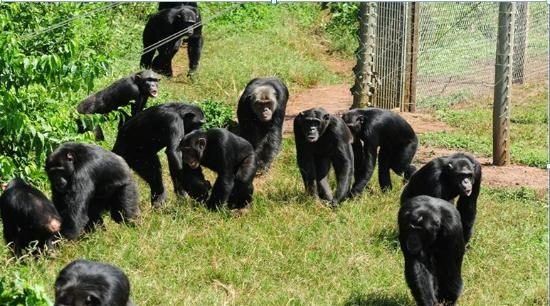
Kampala (Converseer) — In the misty forests of Uganda’s Kibale National Park, the world’s largest chimpanzee community has descended into what scientists are calling the first documented “civil war” among our primate cousins. The dramatic split of the Ngogo chimpanzees — once a thriving group of nearly 200 — has unleashed years of lethal raids, killing at least two dozen individuals and rewriting our understanding of collective violence.
For three decades, primatologists have tracked the Ngogo chimps, whose size dwarfed typical troops of 50 to 60. Featured in Netflix’s “Chimp Empire,” they embodied chimpanzee society at its most stable: flexible subgroups forming and dissolving in a pattern called fission-fusion, bound by kinship and alliances.
That changed in 2015. Tensions simmered as western and central factions avoided each other, triggered by deaths in the male hierarchy that eroded social ties. By 2018, the community had fractured permanently into two rival groups, their former heartland now a brutal no-man’s-land.
The Western splinter group, smaller but tightly knit, launched relentless attacks on the Central faction. From 2018 to 2024, observers witnessed or pieced together evidence of seven adult males and 17 infants slain in raids, with more deaths likely. “They’re targeting former comrades,” said lead researcher Aaron Sandel of the University of Texas at Austin, whose findings appear in this week’s *Science*. “Group identities shifted so fast that old bonds meant nothing.”
Unlike the debated 1970s Gombe clashes during Jane Goodall’s era — tainted by human-fed chimps — Ngogo’s war unfolded naturally. Genetic data pegs such splits at once every 500 years, making this a once-in-a-millennium spectacle.
The implications ripple to humanity. Chimp violence arose without ethnicity, religion, or tools — just fractured relationships. “This suggests polarisation and war might stem from basic social dynamics, not just culture,” Sandel noted. In a world rife with division, the lesson from Uganda’s apes is stark: unity can shatter swiftly.
Comparing Ngogo chimp split violence to the Gombe 1970s war
Key Similarities
Both the Ngogo (2015–present) and Gombe (1974–1978, aka “Four-Year War”) events involved permanent fission of a unified chimpanzee community into rival factions, followed by lethal intergroup violence targeting former affiliates. In each case:
-
Social precursors: Hierarchical instability among males and shifting alliances preceded the split. At Gombe, a rift between high-ranking males (e.g., Humphrey and Figan) fragmented the Kasakela community into northern Kasakela (8 adult males) and southern Kahama (6 adult males) groups. Ngogo saw similar male deaths and avoidance patterns from 2015, exacerbated by a 2017 epidemic and group oversize (~200 individuals).
-
Violence dynamics: Coordinated patrols and ambushes by the larger/stronger faction decimated the smaller one. Gombe’s Kasakela killed all 6 Kahama adult males, plus females/young (total ~10 confirmed deaths); Ngogo’s Western group has slain ≥7 Central adult males and ≥17 infants (2018–2024), with ~14 more suspicious deaths.
-
Outcomes: Victors expanded territory and demography. Gombe’s Kasakela annexed Kahama lands; Ngogo West has gained ground amid ongoing raids into 2026.
Researchers like Richard Wrangham note the “entirely fitting” parallels in lead-up dynamics.
Key Differences
Scholarly Significance
Ngogo provides the “cleaner, more complete” validation of Gombe’s intra-community war, free from provisioning confounds that skeptics highlighted. As Aaron Sandel notes, it confirms relational fractures alone can ignite “civil war” without cultural proxies. Both bolster chimpanzee models for human warfare origins, emphasizing coalition fragility over resource scarcity (abundant at both sites).