- …and what it says about African music
By Ebube Bruno
CALABAR (CONVERSEER) – Yeah! Yeah! It’s actually sweet to be a Tyla or Davido fan. Or anyone’s fan for that matter. Celebrities give us something to talk about, to be excited about! As humorist Fran Lebowitz said in the 2021 American documentary series Pretend It’s A City, Musicians and cooks give us the greatest excitement in life.
The Grammy award held on Sunday kept many music lovers awake, anticipating, applauding or heartbroken.
As a Nigerian, I was hopeful that the artists whose music struck my heartstrings would win. “Sweet Fanta Diallo, I no fit forget oooo” was a melody that got me standing, dancing and calling my favourite girl whenever it played.
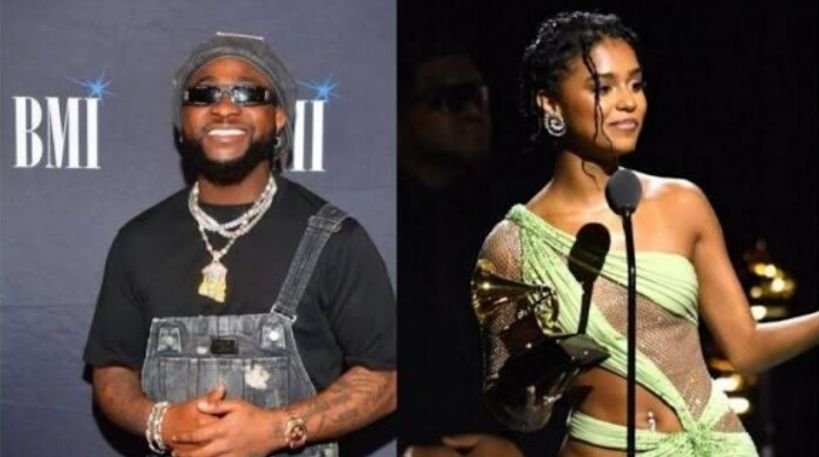
However, it didn’t win the nomination for Best African Music Performance. It was nominated alongside Tyla’s Push and Start. It was the second time the Nigerian was going up against the South African having also lost to her in the inaugural Best African Music Performance when his “Unavailable” was nominated alongside Tyla’s “Water”. That was in 2024.
As a critic however, and as a fan, I have tried finding out why Tyla edged out Davido for the second consecutive time to bag this coveted award. I’ll be looking at it in this article. Ride along with me.
1. The Songs Themselves (linguistic/thematic analysis):
The songs before the Grammy panel; Tyla’s Push 2 Start and Davido’s With You presents unique challenges before the Western-dominated panel. Both are love songs. But Tyla’s use of automotive metaphors (“push to start,” “gas me up,” “floor it”) taps into imagery that’s universally easy to grasp. Davido’s With You leans on cultural specificity with phrases like “Sweet Fanta Diallo” and Nigerian Pidgin-English lines that require cultural context. This is something not all Grammy voters will fully decode. Your sound can be authentic but still opaque to outsiders.
2. Language interference:
Davido’s core theme of romantic devotion is universal, but the execution is culturally specific Metaphors like “Sweet Fanta Diallo” and food references require cultural context. There is heavy use of Nigerian Pidgin English and Igbo language phrases like “I no fit forget you,” “Ebezina,” “nsọgbu,” “Ọmọge,” “Ìdí ará bànkó”. Davido’s code-switching between English, Pidgin, and indigenous languages creates an authentic Nigerian sound. Tyla uses primarily standard English with minimal localised language. “Gyal” is one of the few regional markers (Caribbean/South African influence). Reference to Johannesburg grounds it culturally but doesn’t limit accessibility.
3. The challenge of relatability Pan-African/Global Fusion:
“Push and Start” is more fluid and easier to assimilate for a non-indigene of the language of the singer. It blends Amapiano (South African), Afrobeats, and pop influences. This makes it maintain an African identity while crafting a globally palatable sound. On the other hand, “With You” appeals more to Nigerians; with its reference to Bright Chimezie’s “Because of English”. The Recording Academy has historically favoured songs with broader international appeal that balance cultural authenticity with accessibility. Tyla’s approach mirrors this formula with a production and lyrical approach designed for international markets.
4. Commercial Performance (charts, streaming):
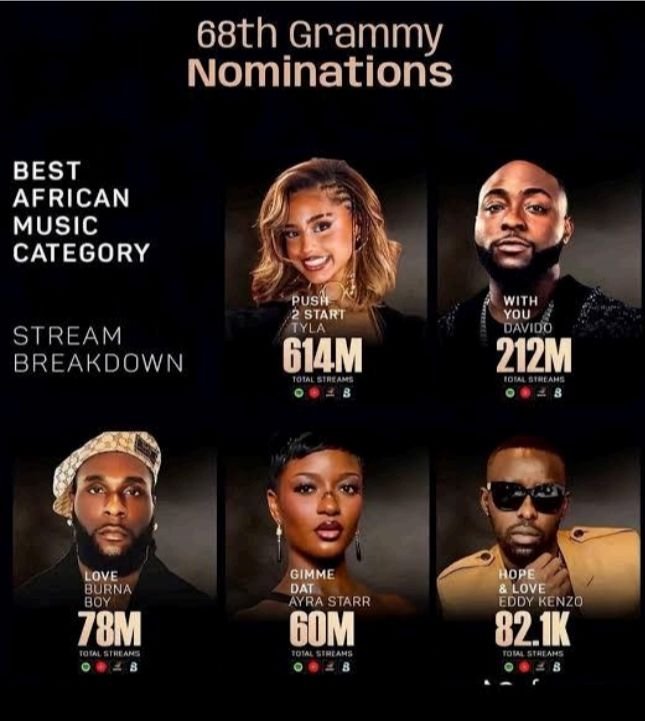
The charts are there for anyone to check. Tyla’s “Water” was the first South African solo artist to break the Billboard Hot 100 in 55 years, whereas Davido’s “Unavailable” peaked lower, mostly focusing on the Afrobeats-specific charts. Tyla became the first African Solo Artist to hit 1 billion Spotify Streams With ‘Water’ Available streaming data suggests that “Push 2 Start” (Tyla) reached significantly higher stream counts compared to “With You”. These numbers say how many people listen to your music and project how much it has made. Note that commercial performance does signal “cultural moment,” which influences perception.
5. Industry Infrastructure (PR, labels, Grammy campaigns):
Tyla is supported by strong international PR. The 24-year-old is signed to Epic Records (a subsidiary of Sony Music). Sony holds approximately 21.7-22% of the global recorded music market. While Davido is an independent artist, with two record labels under him, his competitor is signed directly to Epic Records (a flagship Sony label), giving her full major label machinery. Davido partners with Sony through distribution deals while maintaining independence
through DMW, meaning he has access to Sony’s power but not full integration.
Now that we have considered these primary considerations, let’s look at other things:
6. Popularity:
Both artists are popular. Davido came into the limelight in 2012 and has ruled the music waves since then with over albums and international collaborations. Tyla on the other hand was not known to many until 2024 when her debut album hit us with “Water”, giving her a Grammy nomination and win. Davido released his debut studio album, Omo Baba Olowo on July 17, 2012. At which time there was no Grammy Award for Best African Music Performance. Broader Context (generational politics, category definition, representation).
7. Generational Spark/ Impact:
Davido belongs to the 2010s generation of Afrobeats superstars, often referred to as the “new school” or the generation that brought Afrobeats to global prominence. Tyla who was born in 2002 is Gen Z. For the sake of keeping the spark of music burning for Gen Z and Gen Alpha, it makes more commercial sense to celebrate Tyla over Davido especially if she makes equally great music. Note that the Recording Academy has faced criticism for being out of touch. Awarding younger artists helps counter that narrative while building the next generation of Grammy loyalists.
8. Background:

Tyla’s multi-racial background, combined with her PR that straddles the African and South America Continent helped her numbers, fluidity and acceptability. Her parents Sharleen and Sherwin Seethal have mixed heritage, contributing to Tyla’s Indian, Zulu, Mauritian, and Irish ancestry. Davido is of Nigerian heritage.
9. Best African Music Performance” Category Politics:
This category was only created in 2023, making it relatively new. The Academy is still defining what this award represents. Does it reward the most authentically African sound, or the African artist making the biggest global impact? The back-to-back Tyla wins suggest they’re favouring the latter. One could argue that if the “Best African Music Performance” category consistently rewards the most Westernised, globally accessible African music, it defeats the purpose of having a dedicated African category. Why not just let those songs compete in Pop/R&B categories?
10. The Need Question:
While some may say Davido deserves the award more for his long-standing contribution to the genre, it is my opinion that Tyla needs it more. Davido has over 150 industry awards, while Tyla has about 34. With a career spanning about 14 years, Davido is regarded as a “legend” of modern African music, having paved the way for the genre’s current global popularity. He does not need the prefix “Grammy Winner” to command respect. He’s been pulling global audiences long before this category existed. He has produced successful talents such as Mayorkun, Dremo, and May D. Davido’s career exploded between 2011 and 2015, Tyla’s conception – toddler years. Tyla needs the award to encourage her as an African woman who is making an impact in a male-dominated industry. She is also an inspiration to her generation just as Davido and others were during their time of rising. Her story as a breakthrough artist is more compelling to voters than Davido’s “veteran adds another accolade” narrative.
In conclusion, therefore, based on the 2026 Grammy results and recent career milestones, Tyla and Davido represent two different, yet highly influential eras of African music. Tyla is currently dominating global pop charts with rapid, record-breaking success, while Davido. boasts a long-standing, pioneering legacy as a cornerstone of Afrobeats. As long as the Grammys are dominated by Western ears, songs that land quickly, widely, and without much cultural translation will likely continue getting the nods. I know I said Davido doesn’t need the “Grammy winner” prefix. But it still stings when you bring your story to people who don’t always speak your language. That’s a glass ceiling everyone in global music talks about. The question is should African artists continue to dilute their sound to bag Grammys or stay true to their authenticity? I can’t answer that question for them.