It would revolutionise MENA security, even if it’s only a consultative platform. However, whether it truly stabilises this broad region or inadvertently further destabilises it remains to be seen.
By Andrew Korybko
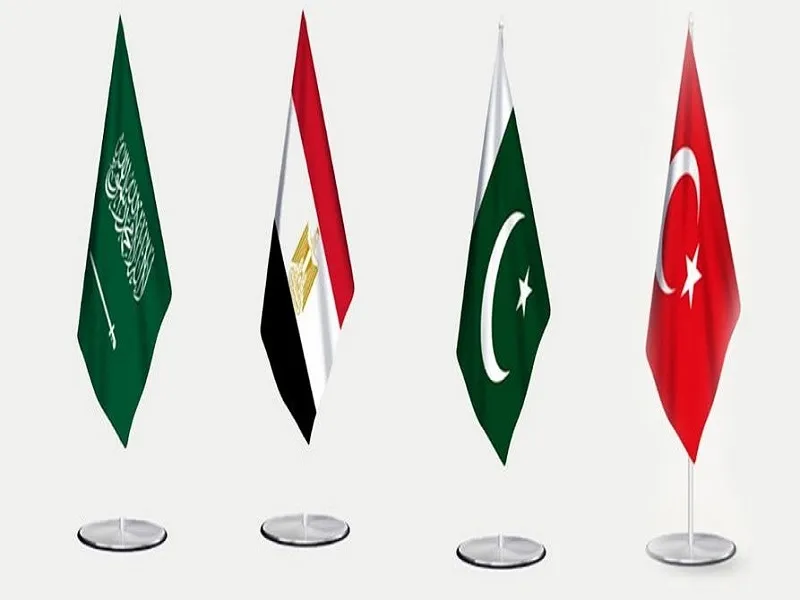
SAN FRANCISCO (CONVERSEER) – There was talk earlier this year of forming an “Islamic NATO” between Saudi Arabia, Pakistan, Turkiye, and Egypt for coordinating policy across the Middle East-North Africa (MENA). Prior to the Third Gulf War, it was thought that Somaliland and Sudan’s “Rapid Support Forces” would be the targets of this alliance, whether it’s formalised or just becomes a consultative platform. While that’s still possible, it might now also hedge against Iran and Israel, which are viewed as security concerns by those four.
The proposed “Islamic NATO” is still in the cards as proven by their Foreign Ministers meeting on the sidelines of a summit in Riyadh in late March. Turkish Foreign Minister Hakan Fidan revealed that “We are exploring how, as countries with a certain degree of influence in the region, we can combine our strengths to solve problems. Above all, we have for some time been saying that the countries of the region should come together, hold discussions and develop ideas. We emphasise regional ownership.”
As it turns out, Russia has also been advocating for “regional ownership” through its Collective Security Concept for the Gulf, which Foreign Minister Sergey Lavrov recently referenced. Given Pakistan’s mutual defence pact with Saudi Arabia, Egypt’s indebtedness to the Kingdom, and Turkiye’s base in Qatar, the grounds exist for expanding Russia’s concept to include those three non-Gulf countries. Ideally, Iran would later join sometime after the war ends, though that of course can’t be taken for granted.
The Collective Security Concept, whether limited to the Gulf or including the three non-Gulf states that are considering forming an “Islamic NATO” with the Saudis, assumes the withdrawal of US forces from the Gulf. Trump’s friend Lindsey Graham recently questioned the wisdom of them remaining there after the Gulf Kingdoms declined to join in the US’ attacks against Iran. It’s therefore possible that Trump might withdraw after the war to focus on dominating the Western Hemisphere and/or containing China.
In that event, the Gulf Cooperation Council (irrespective of the UAE’s inclusion due to its recent tensions with Saudi Arabia) might strengthen its mutual defence capabilities as the Saudi-led core of an “Islamic NATO”, which would then become a consultative platform with the other three non-Gulf countries. Their shared security concerns vis-à-vis Iran and Israel could then be addressed through these means, with Russia encouraging eventual Iranian involvement in this framework, but the group might not consent.
This form of the “Islamic NATO” would serve its members’ interests and help maintain a balance of power in post-war West Asia, but it could also create a new pole of power too, which could lead to two unintended consequences. The first is that Israel, India, the UAE, and others assemble the “Hexagon” that Bibi proposed before the war began to counter the “Islamic NATO” and the second is that the US exploits the “Islamic NATO” to divide-and-rule Afro-Eurasia due to it being located in the centre thereof.
It’s premature to forecast anything further since there are too many variables at play, some of the most important unfolding behind closed doors beyond the public’s view, but the takeaway is that an “Islamic NATO” is still in the cards despite not being talked about as much due to the ongoing Third Gulf War. This framework would revolutionise MENA security even if it’s only a consultative platform, but whether it truly stabilises this broad region or inadvertently further destabilises it would remain to be seen.