









By Frank Ulom
CALABAR (CONVERSEER) – Local Government pensioners in Cross River State have threatened to embark on a statewide protest over what they described as persistent neglect, unpaid entitlements and delayed pensions by the state government.
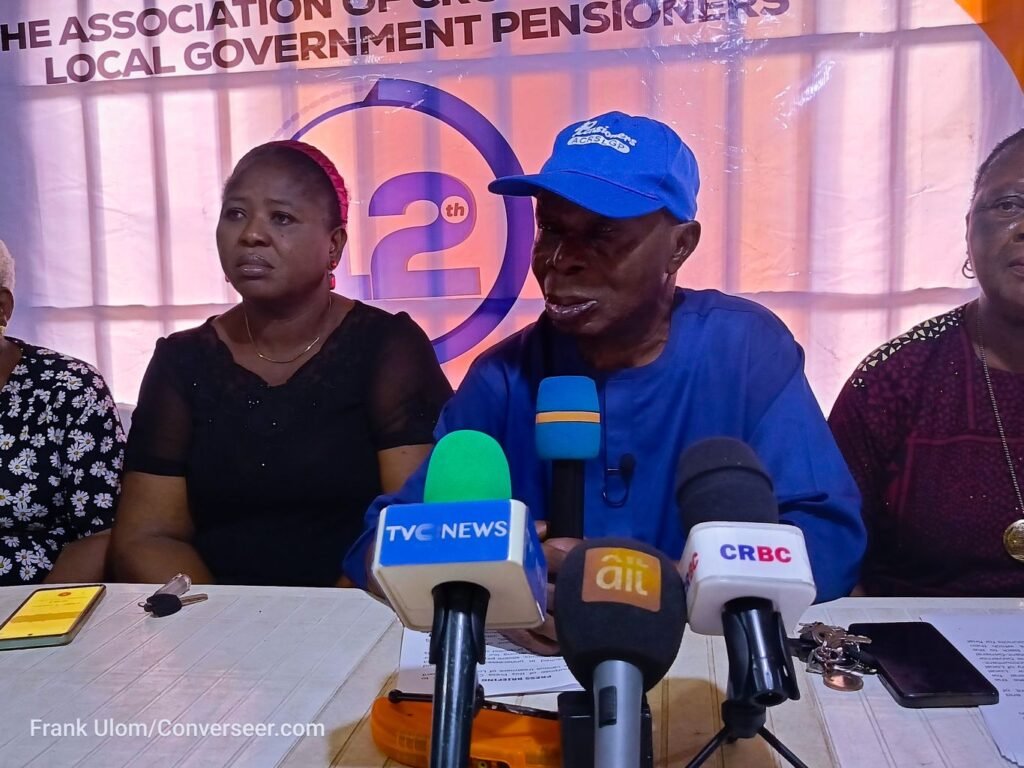
The threat was made on Thursday during a press conference in Calabar by the State Chairman of the Association of Cross River State Local Government Pensioners, Comrade Bassey Okosin.
Okosin said the planned protest became necessary following what he described as the “callous treatment” of retired local government workers, which he said had resulted in prolonged delays in payments, mounting pension arrears and severe hardship among retirees.
According to him, the situation has also caused psychological trauma and avoidable deaths among pensioners who depend solely on their monthly pensions for survival.
“The main purpose of this press conference is to highlight the callous treatment of local government pensioners. This has resulted in unnecessary delays, unpaid backlog of entitlements, severe psychological trauma and avoidable death among our retirees,” Okosin said.
He disclosed that the association had earlier notified the state government of its intention to stage a protest through a letter “Ref. ACRLGP/014/VOL.II/370” dated February 13, 2026, but said no response had been received after two weeks.
Okosin added that the association subsequently issued a reminder letter “Ref. ACRLGP/014/VOL.II/376” on March 2, 2026, warning that the protest would proceed if the government fails to address their demands.
Among the key demands listed by the pensioners is the payment of monthly pensions on or before the end of every month, as well as the inclusion of local government retirees in government palliative programmes such as Christmas and Easter bonuses.

They also called on the Cross River State House of Assembly to pass into law a bill establishing a functional Local Government Pension Board to properly manage pension matters.
Other demands include the harmonisation of pensions for local government retirees, payment of outstanding pension arrears dating back to 2016, implementation of the Consolidated Health Salary Structure (CONHESS) for retired nurses and health workers who served in local government councils, and payment of gratuities to pensioners who were verified in 2024 but are yet to receive their benefits.
The association further demanded the payment of all outstanding pension arrears and the release of a second tranche of gratuities for retirees from 2016 onwards.

Okosin also rejected a proposed plan to transfer the payment of local government pensions to the office of the State Accountant-General, insisting that the responsibility should remain with a properly constituted Local Government Pension Board.
The pensioners’ leader attributed many of the delays in pension payments to what he described as a cumbersome and bureaucratic process involved in the movement of pension vouchers.
He explained that the current system requires vouchers prepared by the Local Government Pension Board to pass through multiple government offices before approval and payment, a process he said causes unnecessary delays.

According to him, vouchers move from the pension board to the Auditor-General for Local Government for verification, then to the Ministry of Local Government Affairs, and subsequently to the Governor through the Accountant-General for approval before being returned to the ministry and later to local government councils for payment.
Okosin argued that a fully operational Local Government Pension Board would simplify the process and ensure quicker payment of pensions.
The association also raised concerns about the staffing of agencies managing local government pensions, alleging that most personnel are drawn from the state civil service rather than the unified local government service.
Okosin said this arrangement undermines accountability and commitment to the welfare of local government retirees.
He cited the 1985 implementation guidelines of the 1976 Local Government Reforms, which stipulate that only career local government staff should be posted to the headquarters of the Local Government Service Commission and the Local Government Pension Board.
According to him, adherence to the guideline would promote better understanding of local government operations and improve service delivery to pensioners.
Okosin further alleged that the absence of a fully functional Local Government Pension Board has worsened the challenges facing retirees.
He noted that although the Local Government Pension Board was established under the 1994 edict, its provisions have not been fully implemented.
The chairman recalled that during the administration of former Governor Prof. Ben Ayade in 2020, a committee was constituted to restructure the pension board. However, he claimed that the committee’s report was never released because it threatened the interests of influential stakeholders.
According to him, two experienced local government officers were later deployed to manage the board and succeeded in streamlining its operations within a year before they were removed and replaced.
He also criticised the period between 2020 and 2023 when the office of the Auditor-General for Local Government allegedly took over the payment of salaries and pensions of local government workers and retirees.
Okosin described the arrangement as abnormal, noting that the same office acted both as auditor and paymaster.
He claimed that during the period, several pensioners were allegedly declared “ghost pensioners” and removed from the payroll.

The development, he said, triggered a peaceful protest by pensioners on November 3, 2020, which led to the blocking of the Murtala Muhammed Highway in Calabar before the situation was eventually resolved.
Okosin maintained that the Ministry of Local Government later took over the responsibility for pension payments, but warned that any further attempt to transfer the function to another agency would be strongly resisted.
“We demand that these agencies hand over the management of local government pensions to the appropriate authority as provided by law,” he said.
He urged the state government to urgently address the concerns of pensioners to prevent the planned protest and alleviate the suffering of retirees.
When contacted, the Speaker of the Cross River State House of Assembly, Rt. Hon. Elvert Ayambem, told journalists on the phone that there are several procedures for the passage of a Bill.
“There are three stages in passing a Bill, which are: first hearing, second hearing, commit it to a committee that’ll call on stakeholders to come for a public hearing, where the views and the opinions of the people would be made known. After that, that is what will now inform the report of the Bill that will be presented to the House and thereafter, onward deliberations will be done and then pass the Bill into Law and then take it to the Governor for assent,” the Speaker said.
Ayambem said the Governor, Senator Bassey Otu, is very meticulous, and so, for any Bill to be passed, it must be people’s friendly.
He stressed that, “It is better to pass a Bill that can add value, rather than enslave or increase the suffering of the people.”
Efforts to get comments from the Head of Service, Orok Bassey Okon, and the Accountant-General, Dr Glory Effiong, proved abortive at the time of filing this report.