By George Effiong-Fuji
CALABAR (CONVERSEER) – Human beings, by their very nature, are averse to harsh climatic elements. This has led to constant improvements by man to avoid unfavourable weather conditions by way of fashioning clothing to suit the prevailing climate, controlling temperature during winter, or installing air conditioners in temperate regions, and designing housing to either ventilate or suppress harsh weather conditions, in order to derive bodily comfort and achieve sound health.
In a sub-Saharan African country like Nigeria, with its arid dry weather in the north, and wet rain forest regions of the south, there is one simple but important public infrastructure that is often underrated or not given its pride of place by policymakers and city planners in Nigeria. And that piece of public infrastructure, often overlooked, is the bus shelter.
Personally, I have always underrated its importance until Thursday, 31st July, when a relentlessly torrential ‘Calabar rain’ (Calabar is a city in the rain forest belt of southern Nigeria), decided to conclusively decide the daily routine for those of us who do not drive. If not for the bus shelter that sheltered yours truly and other miscellaneous people who had one or two morning appointments to catch up with, the heavy downpour would have thoroughly drenched me beyond the marrow.
Bus shelters are found in city centres around the world, including Nigeria. They are structures that mostly passengers/commuters and city dwellers use by waiting or sitting while waiting for a bus at bus stops. It is commonly referred to as a bus shelter, and is an essential structures that serve a practical local purpose.
Typically, they are put in place to provide protection from the elemental weather conditions such as the wind, rain or sun. They often come with seating arrangements, and sometimes include informational signage about bus schedules and routes for passengers.
The aforementioned description paints an ideal picture of basic comfort while waiting to commute on a bus, but the reality on the ground posits discomfort in parts of Nigeria. Government neglect, due to systemic corruption, has rendered many bus shelters in the country to be in a deplorable and redundant condition.
This important public infrastructure has been reduced to a living room for the mentally challenged to occupy. Apart from infrastructural decay, its surroundings are unkempt and abandoned, thus becoming a home for rodents and other dangerous animals to thrive. In fact, such bus shelters cannot shelter sane human beings.
In Calabar, my city of residence, the preceding scenario was what used to be the state of bus shelters until the current administration took the mantle of leadership.
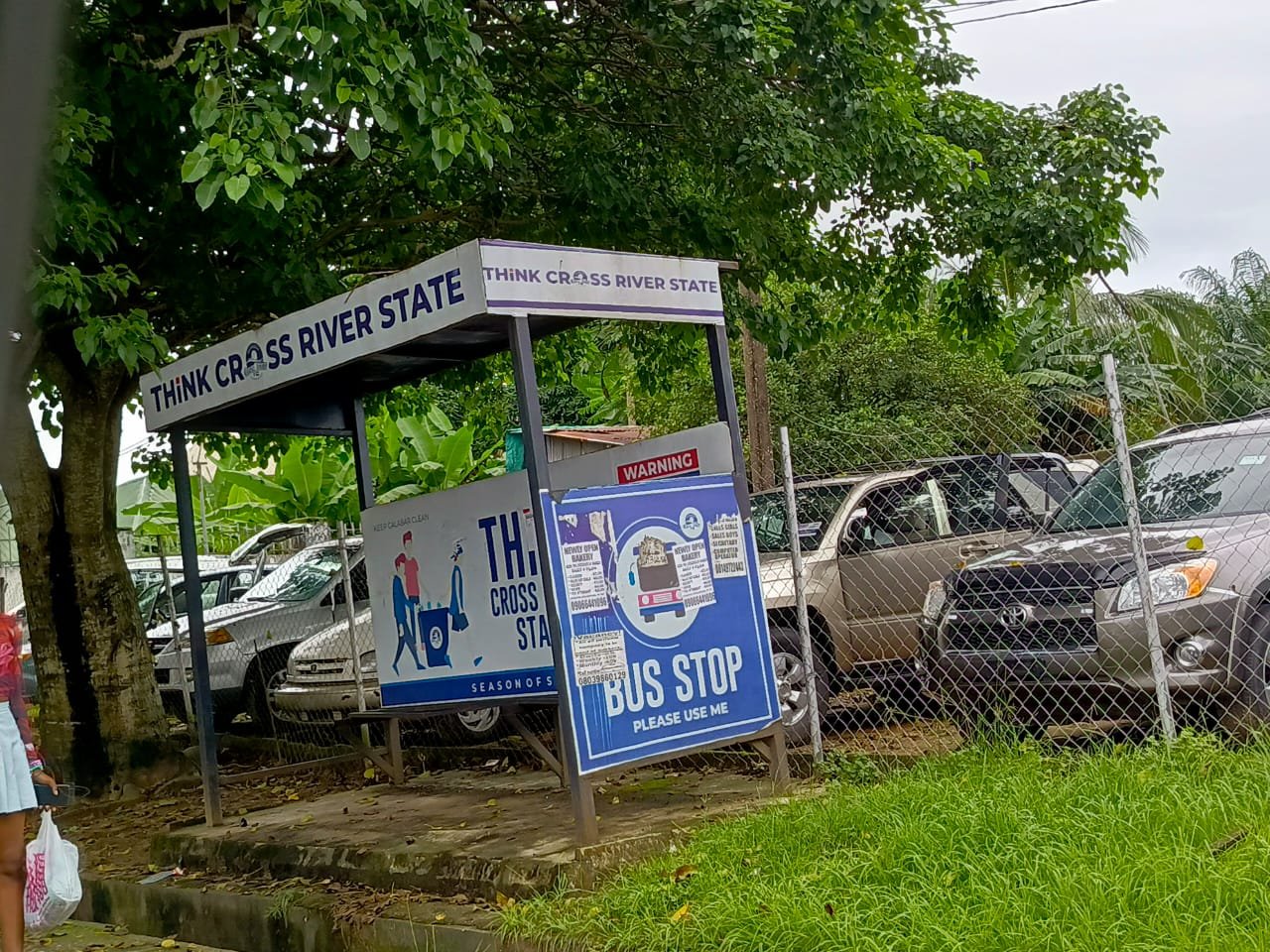
Recently, bus sheltering infrastructures in Calabar metropolis such as the ones around IBB/stadium axis, UNICAL gate axis, 8 miles, etc, have experienced a facelift by way of reconstructions and renovations for the public good, although new ones need to be constructed, and existing ones renovated in remote parts of the city and state.
Noteworthy to state that this opinion piece is not intended to achieve political points, demarket or sell a specific candidate/party, but objectivity, fairness and balance is the grundnorm.
There is an urgent need for governments at all levels, good-spirited individuals, philanthropists, NGOs, organisations, trade unions, thrift and co-operatives, corporate entities, etc, to prioritise and adopt bus shelters as their corporate social responsibilities, and look in the direction of this common public infrastructure that possesses the propensity to be of service to all and sundry, irrespective of one’s social class or status.
Let all hands be on deck to improve this important social amenity for all. As for my Thursday experience with the ‘Calabar rain’, all thanks to the bus shelter located opposite the University of Calabar main gate which provided succour to a commoner in times of unwarranted elemental embarrassment, especially in this rainy season.